As cryptocurrency continues to embed itself in the global financial system in 2025, regulatory bodies across the world have emphasized the importance of transparency and legitimacy. Central to these efforts is the implementation of Know Your Customer (KYC) protocols, which cryptocurrency exchanges and platforms increasingly adopt to verify user identities. Despite the decentralized ethos underpinning many crypto projects, KYC has become essential in preventing fraud, money laundering, and other illicit activities, transforming how users interact with digital assets. This evolving landscape demands a clear understanding of what KYC entails in crypto, the documents required, and how this verification process shapes market trust and security.
At the heart of KYC is identity verification, which bridges traditional financial compliance with the dynamic crypto ecosystem. Financial institutions, including prominent centralized exchanges, require users to submit identification documents like passports, driver’s licenses, or national ID cards along with proof of residency. These measures aim not only to confirm identities but also to continuously monitor transactions for suspicious activity. Technologies such as biometric authentication and advanced AI-enabled verification tools now expedite this process, albeit with growing concerns about privacy and data protection. Meanwhile, platforms like Chainalysis and Onfido provide sophisticated compliance solutions to reconcile the need for security with user experience.
While some crypto enthusiasts prefer the autonomy offered by decentralized exchanges that forego KYC, the majority of mainstream users engage with platforms that require detailed documentation. This transition reflects the balancing act between innovation and regulatory prudence, ensuring that the crypto market matures without compromising its foundational purpose. Looking forward, enhancements in blockchain-based identity verification and AI promise to make KYC faster and more secure, reducing friction while maintaining rigorous compliance.
In brief:
– KYC in crypto involves a multifaceted identity verification process essential for regulatory compliance and market security.
– Users typically provide government-issued IDs and proof of address to exchanges to verify their identities.
– Platforms utilize advanced technologies like biometric checks and AI to streamline verification and ongoing monitoring.
– While KYC raises privacy concerns, it is vital to combat fraud, money laundering, and terrorist financing in the crypto space.
– Alternatives such as decentralized exchanges offer KYC-free trading but with practical limitations and different risk profiles.
Understanding Crypto KYC: Why Identity Verification Matters
Know Your Customer (KYC) in cryptocurrency mirrors the identity verification processes long established in traditional finance. Originating from Anti-Money Laundering (AML) and Counter Financing of Terrorism (CFT) regulations, KYC requires crypto platforms, especially centralized exchanges, to verify client identities before allowing substantial transactions or account openings. This process benefits all parties by reducing fraudulent activities and enhancing trust within the trading ecosystem. For users, this means preparing to submit personal information such as their full name, birthdate, and address, alongside valid identification, to comply with local laws.
Global standards from the Financial Action Task Force (FATF), supported by agencies like FinCEN in the US and the UK’s FCA, influence KYC policies worldwide. Platforms including Binance and Coinbase embed KYC workflows that sometimes integrate solutions from compliance specialists like Jumio, Trulioo, or IdentityMind to ensure thorough screening and meet evolving regulatory requirements. This systemic approach helps identify and prevent the movement of illicit funds, while also deterring market manipulation and adding credibility to the crypto domain.

Key Documents Required for Crypto KYC
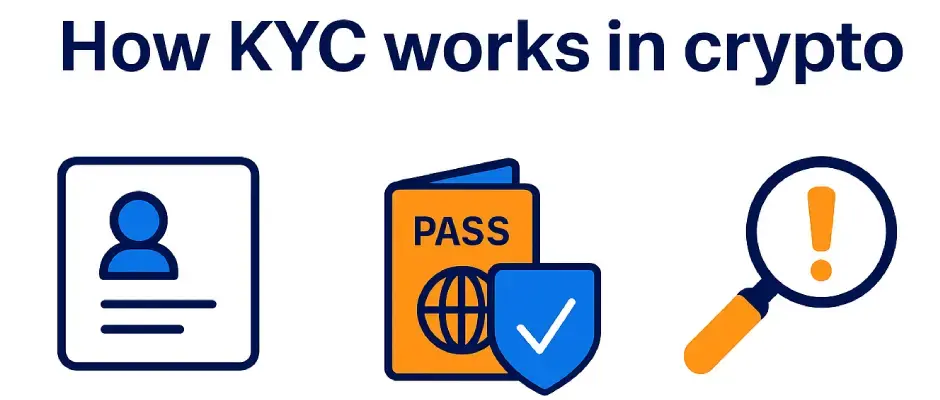
To navigate the KYC process, customers must provide a set of official documents that verify their identity and residence. The standard documents include:
- Government-issued photo ID: This could be a passport, driver’s license, or national identification card. The ID needs to be current and clearly legible to ensure validity.
- Proof of address: Typically a recent utility bill, bank statement, or official lease agreement showing the user’s residential address, which confirms their physical location and helps detect fraudulent activity.
- Selfie or liveness check: Many exchanges require a real-time selfie or a short video where the user follows prompts such as turning their head. This biometric validation ensures the identity documents are not misappropriated or faked.
Depending on jurisdiction and platform policies, additional documentation such as tax identification numbers or proof of income may be requested to comply with legal frameworks and enhance risk profiling. Services like Civic and IDnow offer technology that simplifies these data collections while maintaining compliance with privacy regulations.
How the Crypto KYC Process Works in Practice
When users initiate the KYC process, they generally start by registering an account on a crypto exchange or wallet service. After supplying personal details and uploading required documents, the platform leverages a combination of automated and manual checks. AI-powered systems, including optical character recognition (OCR) and biometric verification, scrutinize the authenticity and consistency of the submitted identity proof.
Cross-referencing against global watchlists and fraud detection databases is typically performed by solutions from providers like Elliptic and Sumsub, which specialize in crypto compliance. Once verification succeeds, users usually gain access to expanded trading limits and withdrawal capabilities. Yet, this marks only the beginning: exchanges continuously monitor transactions to spot signs of suspicious behavior, adjusting the risk profile and sometimes requesting further verification.
Users should anticipate that the initial KYC review may take from a few minutes up to 48 hours, depending on the exchange’s processes and workload. This delay is a trade-off for enhanced security and regulatory alignment, ensuring a safer trading environment for all participants.
Challenges and Controversies Around KYC in Crypto
Despite its critical role, KYC remains controversial among crypto advocates who prize privacy and decentralization. Collecting and storing sensitive personal information can pose significant risks if data breaches occur. For example, the 2024 reported breach affecting an Iranian-based exchange spotlighted vulnerabilities inherent in centralizing sensitive KYC data.
Moreover, the mandatory nature of KYC can deter users who seek anonymity or find the verification process cumbersome. This friction can push some to unregulated or decentralized platforms lacking KYC, which, while preserving privacy, pose increased risks of fraud and limited market liquidity. Regulatory inconsistencies between jurisdictions further complicate KYC compliance for global exchanges, often requiring duplicate verification efforts and increased overhead costs.
Alternatives to KYC: Decentralized and Non-KYC Crypto Platforms
For users seeking to avoid traditional KYC procedures, several avenues exist, although with caveats. Decentralized exchanges (DEXs) such as Uniswap offer no KYC requirements, facilitating direct wallet-to-wallet trades through smart contracts. However, these platforms usually require users to hold compatible cryptocurrencies already and provide limited fiat on/off-ramps.
Some centralized exchanges still allow limited trading without full KYC, typically with capped withdrawal amounts. Crypto ATMs provide another KYC-lite option, usually requiring only a phone number for smaller transactions but often with higher fees compared to traditional exchanges. Peer-to-peer marketplaces like Bisq enable users to transact crypto directly without institutional intermediaries, though liquidity and pricing can vary significantly.
Despite these options, centralized exchanges remain the primary gateway for most users, especially those dealing in fiat currency conversions or large trade volumes, reaffirming the necessity of KYC for security and compliance.
The Evolving Future of KYC in Cryptocurrency
As regulatory scrutiny intensifies, crypto platforms are increasingly adopting cutting-edge technologies to balance compliance, efficiency, and user privacy. Blockchain-based identity verification systems, exemplified by projects like KYC-Chain, promise to create reusable digital identities, reducing duplication and customer onboarding times. Artificial intelligence and machine learning, integrated with tools such as ShadowDragon Horizon, enhance risk detection accuracy by correlating on-chain activity with open-source intelligence.
Such innovations aim to transform KYC from a burdensome hurdle into a streamlined, privacy-conscious process that supports industry growth while safeguarding users. Forward-looking exchanges embedding compliance solutions from trusted vendors like Trulioo and Shyft position themselves to comply with evolving regulations and maintain competitive trust in a maturing market.